
12/7/11

11/30/11
Let’s focus on Tablets Chocolate Market
To diversify their activity and resist to the crisis, fabricants need to innovate in terms of tastes into the tablet chocolate market.
4 majors’ categories:
· - Plain (black) chocolate
· - Milk chocolate
· - White chocolate
· - Cooking chocolate
Lately, fabricants invested a lot to diversify choices to always seduce consumers, they now innovate:
· - Texture: mousse chocolate.
· - Taste: additional components as almonds, nuts, fudge, vanilla, honey, fruits…

And you what is your favorite tablet?
11/29/11
The Chocolate Industry
French people and Chocolate addiction
Chocolate is an important product, particularly so in France, as it is the sector among the best performers in the entire food sector. The chocolate market in France is a sector dominated by seven large companies including KJS, Nestle and Lindt.
Chocolate is a product whose consumption has registering new highs on the French market. In the last 20 years, consumption has increased by 20%.
According to experts, it should still continue in the same manner in future years. However, many discussions have arisen around the industry. The Cocoa producing countries are facing multiple crises and this could jeopardize the consumption in France. In addition, internal debates are raging between artisans and firms. In this document, we will study the current situation in the French market Chocolate.
Chocolate is a product of high consumption. Indeed, there is a wide variety of brands, owned by companies such as Ferrero, Nestle and Poulain, leaving consumers with a mind boggling array of choice, especially as companies constantly try to differentiate themselves from each other by diversifying their offers.
Brands must constantly innovate to remain competitive in this market. For example, chocolate can be light or dark, it can be marketed in tablet form or as a spread.
Brands must constantly innovate to remain competitive in this market. For example, chocolate can be light or dark, it can be marketed in tablet form or as a spread.

Source: http://www.oboulo.com/
11/24/11
Let's analyse the market chocolate by products
Hello Bloggers,
Below a chart describing the chocolate market by products
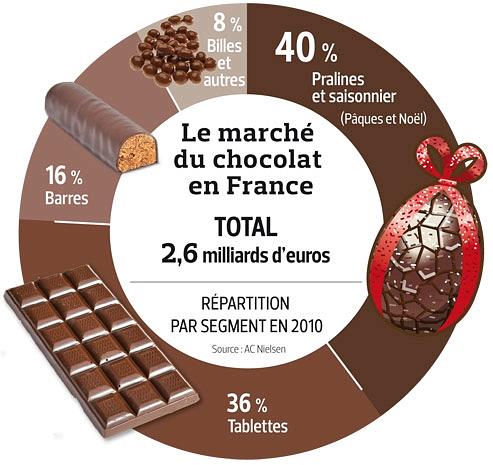
In total, a strong and dynamic market of 2,6 billions euros segmented in
- Barres
- Balls
- Praline-Seasonal (Christmas- Easter)
- Tablets
According AC Nielsen, market chocolate has raised by 2,8% in value this year.
And you bloggers which kind of chocolate do you prefer?
11/21/11
Chocolate and Health
Hello Bloggers,
After surfing on the web we found some good news for chocolate's fan !
Good news for woman:
Thanks to some Swedish searcher, we have the confirmation that Chocolate has a good effect for woman:
"The study found that women who had the highest consumption of chocolate -- about two candy bars a week -- had a 20 percent reduced risk of stroke."
We will keep posting the latest news but if you want to more about the research, check out this website:
11/7/11
Chocolate History (4)
CHOCOLATE AS WE KNOW IT
The first mention of chocolate being eaten in solid form is when bakers in England began adding cocoa powder to cakes in the mid 1600's. Then in 1828 a Dutch chemist, Johannes Van Houten, invented a method of extracting the bitter tasting fat or "cocoa butter" from the roasted ground beans, his aim was to make the drink smoother and more palatable, however he unknowingly paved the way for solid chocolate as we know it.
Chocolate as we know it today first appeared in 1847 when Fry & Sons of Bristol, England - mixed Sugar with Cocoa Powder and Cocoa Butter (made by the Van Houten process) to produce the first solid chocolate bar then, in 1875 a Swiss manufacturer, Daniel Peters, found a way to combine (some would say improve, some would say ruin) cocoa powder and cocoa butter with sugar and dried milk powder to produce the first milk chocolate. Source: Aphrodite Chocolate
Chocolate History (3)
The Quakers were, and still are, a pacifist religious sect, an offshoot of the Puritans of English Civil War and Pilgrim Fathers fame and a history of chocolate would not be complete without mentioning their part in it. Some of the most famous names in chocolate were Quakers, who for centuries held a virtual monopoly of chocolate making in the English speaking world - Fry, Cadbury and Rowntree are probably the best known.
It's probably before the time of the English civil war between Parliament and King Charles 1st, that the Quaker's, who evolved from the Puritans, first began their historic association with Chocolate. Because of their pacifist religion, they were prohibited from many normal business activities, so as an industrious people with a strong belief in the work ethic (like the puritans), they involved themselves in food related businesses and did very well. Baking was a common occupation for them because bread was regarded as the biblical " Staff Of Life", and Bakers in England were the first to add chocolate to cakes so it would be a natural progression for them to start making pure chocolate. They were also heavily involved in breakfast cereals but that's another story.
What is certain is that the Fry, Rowntree and Cadbury families in England among others, began chocolate making and in fact Joseph Fry of Fry & Sons (founded 1728 in Bristol, England) is credited with producing and selling the worlds first chocolate bar. Fry's have now all but disappeared (taken over by Cadbury) and Rowntree have merged Swiss company Nestle, to form the largest chocolate manufacturer in the world. Cadbury have stayed with chocolate production and are now, if not quite the largest, probably one of the best known Chocolate makers in the world.
From their earliest beginnings in business the Quakers were noted for their enlightened treatment of their employees, providing not just employment but everything needed for workers to better themselves such as good housing etc. In fact, Cadbury built a large town for their employees around their factory near Birmingham, England. Complete with libraries, schools, shops and Churches etc, they called it Bourneville. So next time you see Cadbury's chocolate with the name Bournville on it you will know where it comes from and what the name
Source: Aphrodite Chocolate
 |
| Elizabeth Cadbury |
 |
| George Cadbury |
Chocolate History (2)
CHOCOLATE IN EUROPE
Xocolatl! or Chocolat or Chocolate as it became known, was brought to Europe by Cortez, by this time the conquistadors had learned to make the drink more palatable to European tastes by mixing the ground roasted beans with sugar and vanilla (a practice still continued today), thus offsetting the spicy bitterness of the brew the Aztec's drank.
The first chocolate factories opened in Spain, where the dried fermented beans brought back from the new world by the Spanish treasure fleets were roasted and ground, and by the early 17th century chocolate powder - from which the European version of the drink was made - was being exported to other parts of Europe. The Spanish kept the source of the drink - the beans - a secret for many years, so successfully in fact, that when English buccaneers boarded what they thought was a Spanish 'Treasure Galleon' in 1579, only to find it loaded with what appeared to be 'dried sheep's droppings', they burned the whole ship in frustration. If only they had known, chocolate was so expensive at that time, that it was worth it's weight in Silver (if not Gold), Chocolate was Treasure Indeed!
Within a few years, the Cocoa beverage made from the powder produced in Spain had become popular throughout Europe, in the Spanish Netherlands, Italy, France, Germany and - in about 1520 - it arrived in England.
The first Chocolate House in England opened in London in 1657 followed rapidly by many others. Like the already well established coffee houses, they were used as clubs where the wealthy and business community met to smoke a clay pipe of tobacco, conduct business and socialise over a cup of chocolate.
Source: Aphrodite Chocolate
Source: Aphrodite Chocolate
 | |
| General Cortez |
Chocolate History (1)
EARLY HISTORY OF CHOCOLATE
The earliest record of chocolate was over fifteen hundred years ago in the Central American rain forests, where the tropical mix of high rain fall combined with high year round temperatures and humidity provide the ideal climate for cultivation of the plant from which chocolate is derived, the Cacao Tree.
The Cacao Tree was worshipped by the Mayan civilisation of Central America and Southern Mexico, who believed it to be of divine origin, Cacao is actually a Mayan word meaning "God Food" hence the tree's modern generic Latin name 'Theobrama Cacao' meaning ‘Food of the Gods’. Cacao was corrupted into the more familiar 'Cocoa' by the early European explorers. The Maya brewed a spicy, bitter sweet drink by roasting and pounding the seeds of the Cacao tree (cocoa beans) with maize and Capsicum (Chilli) peppers and letting the mixture ferment. This drink was reserved for use in ceremonies as well as for drinking by the wealthy and religious elite, they also ate a Cacao porridge.
The Aztecs of central Mexico also prized the beans, but because the Aztec's lived further north in more arid regions at higher altitudes, where the climate was not suitable for cultivation of the tree, they had to acquire the beans through trade and/or the spoils of war. The Aztecs prized the beans so highly they used them as currency - 100 beans bought a Turkey or a slave - and tribute or Taxes were paid in cocoa beans to Aztec emperors. The Aztecs, like the Mayans, also enjoyed Cacao as a beverage fermented from the raw beans, which again featured prominently in ritual and as a luxury available only to the very wealthy. The Aztecs called this drink Xocolatl, the Spanish conquistadors found this almost impossible to pronounce and so corrupted it to the easier 'Chocolat', the English further changed this to Chocolate.
The Aztec's regarded chocolate as an aphrodisiac and their Emperor, Montezuma reputedly drank it fifty times a day from a golden goblet and is quoted as saying of Xocolatl: "The divine drink, which builds up resistance and fights fatigue. A cup of this precious drink permits a man to walk for a whole day without food"
In fact, the Aztec's prized Xocolatl well above Gold and Silver so much so, that when Montezuma was defeated by Cortez in 1519 and the victorious 'conquistadors' searched his palace for the Aztec treasury expecting to find Gold & Silver, all they found were huge quantities of cocoa beans. The Aztec Treasury consisted, not of precious metals, but Cocoa Beans.
Source: Aphrodite Chocolate
11/6/11
The organization of the Market for industrial Chocolate
There is no boundaries between cocoa processors and chocolate manufacturers as most cocoa processors also produce couverture (industrial chocolate).Producers of industrial chocolate fall into two broad categories:
1) Largest manufacturers of branded consumer articles that produce their industrial chocolate and mainly use it inhouse to make consumer products (integrated chain) : Nestlé, Mars, Hershey, Cadbury, Kraft, Jacobs Suchard, Ferrero and Cemoi.
2) Leading cocoa-processing companies that supply most of their output of couverture to third parties : Barry Callebaut, Cargill, ADM and Bloomer
"In the past, chocolate companies were more diverse than at present and mainly consisted of companies marketing their products on their own domestic markets. The market is now dominated by large multinational confectionery companies, which market their brands in all major consumer countries. Following a series of mergers and acquisitions in the chocolate industry, five companies alone – Nestlé, Ferrero, Mars, Kraft Jacobs Suchard, and Cadbury Schweppes – have come to control more than half of the European market for consumer chocolate. This aggregate figure masks a higher degree of concentration in specific national markets and for specific product categories. Already in the mid-1990s, for example, Cadbury, Mars and Nestle accounted for approximately 75–80 per cent of the UK chocolate confectionery market."
Cocoa Industry Structures and Competition, United Nations 2008
Subscribe to:
Posts (Atom)